
 MENU
MENU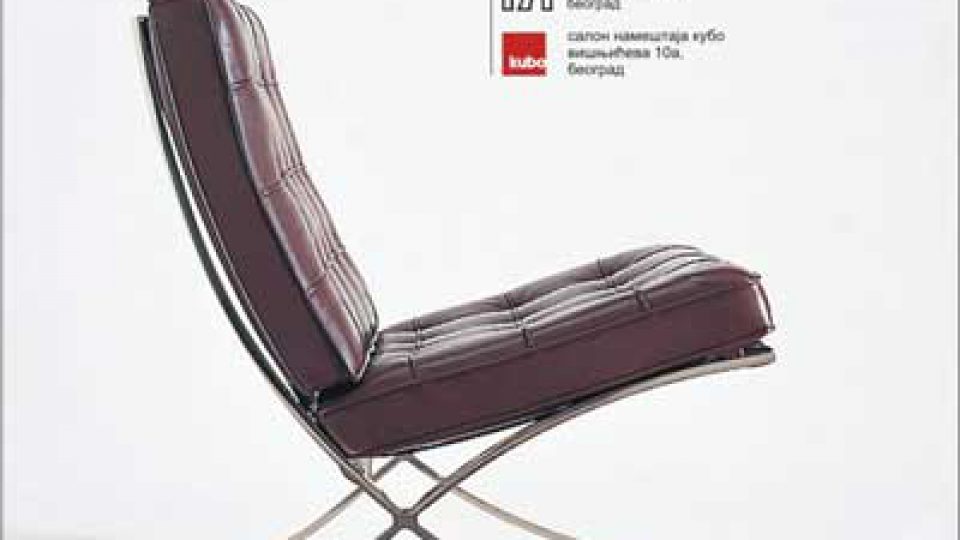
Bojana Popović MA, Senior Curator
During the last decade of the nineteenth century witnesses the arrival of avant-garde in art, encompassing works of art that within themselves carry ideas ad their visual interpretation, not entirely close and understandable to their contemporaries, and that, by means of its modernism open new possibilities of perception of reality and anticipate the future. In time the most valuable modern works have become classic values. Exactly that kind of works of the modern movement and international style in furniture design are presented at this exhibition, organized in the cooperation between the Museum of Applied Art and the Belgrade company ”Kubo”, which represents ”Cassina” i ”Knoll” – two of the most prestigious manufacturers and retailers of world’s most significant designers.
The exhibition presented works by Charles Rennie Mackintosh, Frank Lloyd Wright, Gerrit Thomas Rietveld, Marcel Breuer, Le Corbusier, Charlotte Perriand, Piere Jeanneret, Ludwig Mies van der Rohe, Harry Bertoia and Eero Saarinen.

Le Corbusier – Charles Edouard Jeanneret (1887, La-Chau-de-Fond, Switzerland - 1965, Cape Martin, France) Charlotte Perriand (1903 – 1999) Pierre Jeanneret (1896 – 1967) Polufotelja Baskilan (Basculant, LC1) oko 1928. godine Chromed steel, pony leather Length, width, height: 60 x 65 x 64 cm Cassina has produced it since 1965
The semi-armchair has a mobile back (basculant), and it was named after it. It is made of chromed steel, with a seat and back originally in leather, which later versions exchanged to more luxurious types, as is pony leather. The first version, produced by the Thonet company (Freres Thonet, Paris, since 1929) exhibits influence by Marcel Breuer’s Wasilly armchair.
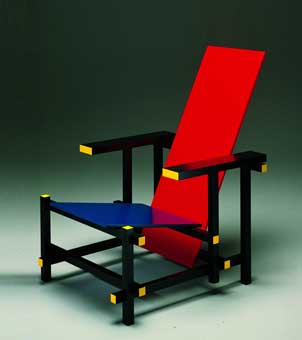
Gerrit Thomas Rietveld (1888, Utrecht - 1964, Utrecht) Red and Blue armchair (635 Red and Blue) 1917-1923 Dyed and lacquered beech, plywood Length, width, height: 65,5 x 83 x 88 cm Cassina has produced it since 1973
This armchair is the first radically new solution that defined the aesthetics of design of the twentieth century. It was named after the colours applied, whose choice and setting was greatly influenced by the painting of Piet Mondrian and Theo van Doesburg, the ideologists of the De Stijl movement. The colour serves to define strict, geometrical construction, achieved by flat tables of the seat and the back of the chair which are set in the frame of exquisitely emphasized linearness. The parts of the chair and their colours are brought together so well, that they manage, to an extent, to blur out the edges between the object itself and the surrounding environment, between the concrete and the abstract.
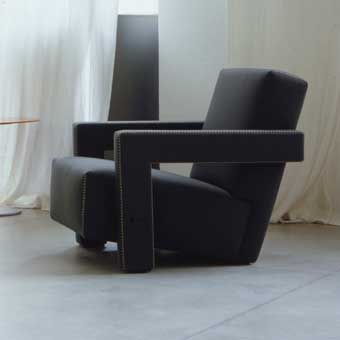
Gerrit Thomas Rietveld (1888, Utrecht - 1964, Utrecht) Utrecht armchair (637 Utrecht) 1935 Steel, polyurethane foam, polyester, plastics, leather Length, width, height: 64 x 85 x 70 cm Cassina has produced it since 1988
Every part of the Utrecht armchair is upholstered, with seams along the edges as the only decorative element. Rietveld continued to design upholstered furniture, but he never achieved such perfect symbiosis of modernism and art deco.

Le Corbusier – Charles Edouard Jeanneret (1887, La-Chau-de-Fond, Switzerland - 1965, Cape Martin, France) Charlotte Perriand (1903 – 1999) Pierre Jeanneret (1896 – 1967) Grand Confort – small model (Grand Confort, LC 2) 1928 Chromed steel, leather Length, width, height: 76 x 70 x 67 cm Cassina has produced it since 1965
The armchair is formed by five pillows set within a frame made of steel pipes. Designed in 1928, it was the first example of the radically new type, developed later by Le Corbusier, as well as by other designers. That same year Grand Confort – large model (LC4), which is slightly bigger and with one pillow less on its seat. These armchairs, by means of their form, modernize the old type of the so-called club armchair Le Corbusier valued for their simplicity. Before he started designing furniture, he had furnished houses he designed with Thonet furniture and club sets.

Charles Rennie Mackintosh (1868, Glasgow - 1928, London) Hill House chair I (292 Hill House I) 1902 Black dyed ash, velvet Length, width, height: 41 x 35 x 141 cm Cassina has produced it since 1973
The chair was designed for the bedroom of the Hill House in Helensburg Mackintosh designed for Walter Blackie, the publisher, from 1902 to 1905. The seat had been originally upholstered with a green and purple material.

Le Corbusier – Charles Edouard Jeanneret (1887, La-Chau-de-Fond, Switzerland - 1965, Cape Martin, France) Charlotte Perriand (1903 – 1999) Pierre Jeanneret (1896 – 1967) Easy chair (Chaise-longue, LC 4) 1928 Lacquered and chromed steel, pony leather Length, width: 160 x 56,4 cm Cassina has produced it since 1965
The easy chair has a dyed steel stand, in the form of the letter H, supporting a steel pipe construction with an ergonomically shaped seat, upholstered with leather. The seat can be placed in different positions. The concept of the chair was Le Corbusier’s, but the credits for its final form go to Charlotte Periand. In the first versions the chair did not have a static stand, but it functioned as a swing instead.

Le Corbusier – Charles Edouard Jeanneret (1887, La-Chau-de-Fond, Switzerland - 1965, Cape Martin, France) Charlotte Perriand (1903 – 1999) Pierre Jeanneret (1896 – 1967) Working chair (LC 7) 1928 Chromed steel, leather Length, width, height: 60 x 58 x 73 cm Cassina has produced it since 1978
As well as other pieces of furniture designed in 1928, this round chair is made of chromed steel pipes and leather. It is designed in such a way so that the seat can rotate. There are a couple of versions of this chair, and one drawing by Charlotte Periand shows that it was also intended for the dining-room.
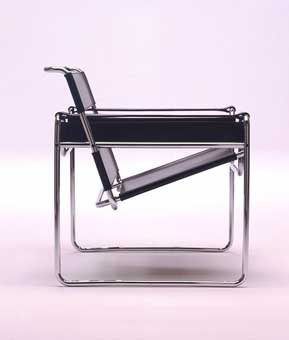
Marcel Laiko Breuer (1902, Pecs - 1981, New York) Wassily armchair (Wassily) 1925-1927 Chromed steel, cloth Length, width, height: 79 x 72 x 100,5 cm Knoll has produced it since 1968
Interest in standardization and serial production, familiar with the programme of the Bauhaus, inspired Marcel Breuer to recognize metal pipes as a material convenient for furniture production that will present interior with a new structure. He started thinking about metal pipes as constructive elements of modern furniture in 1925, admiring his new bicycle, which was made of steel pipes. That same year Breuer made the prototype of his first pipe armchair, helped by the tinsmith who soldered the parts into the desired construction. To achieve the impression of transparency, lightness and elasticity, the seat and the back had originally been made of pieces of cloth.

Charles Rennie Mackintosh (1868, Glasgow - 1928, London) Willow armchair (312 Willow) 1904 Black dyed ash, cloth Length, width, height: 94 x 41 x 119 cm Cassina has produced it since 1973
The armchair was named after Miss Catherine Cranston’s teahouse Mackintosh worked on from 1903 to 1906, refurnishing the building and completely designing its interior.

Frank Lloyd Wright (1867, Richland centre, USA – 1959, Phoenix, USA) Barrel armchair (606 Barrel) 1937 Cherry tree, cloth Length, width, height: 54,5 x 55,5 x 81 cm Cassina has produced it since 1986
The armchair was designed in 1937 for the Wingspread house, belonging to Herbert F. Johnson, in Wind Point, Wisconsin. The seat had been originally upholstered with leather.

Ludwig Mies van der Rohe (1886, Achen – 1969, Chicago) Barcelona armchair, 1929
Polished steel, aluminum, leather Length, width, height: 75 x 76 x 77 cm Knoll has produced it since 1948

Ludwig Mies van der Rohe (1886, Achen – 1969, Chicago) Barcelona table, 1929
Chromed steel, glass Length, width, height: 100 x 100 x 46 cm Knoll has produced it since 1948
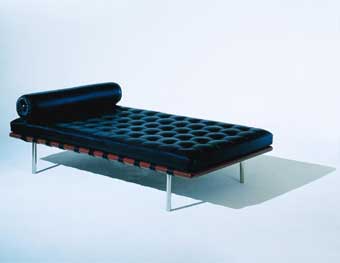
Ludwig Mies van der Rohe (1886, Achen – 1969, Chicago) Barcelona sofa, 1929-1931
Polished steel, lacquered wood, leather Length, width: 198 x 99 cm Knoll has produced it since 1948
In the spacious interior of the German pavilion, erected for the international industrial exhibition in Barcelona 1929, armchairs, stools and tables were exhibited, that are produced today under the common name of Barcelona. The armchair and the stool have a simple, X-shaped construction, made of chromed and polished steel, upholstered with leather. Much alike a modern design for a royal throne, which reminds of the mediaeval X chair, it also serves its prime function – as a resting place for the Spanish royal couple during their walk around the exhibition. At the same time, the armchair and the other pieces of furniture from the pavilion promoted the use of steel pipes and simple, non-decorated forms in the design of luxurious furniture.
The timeless beauty of the Barcelona pavilion furniture and the adhering sofa was achieved through a perfect balance of the proportions, function and craftsmanship, according to Mies’s principles “less is more” and “God is in details”. His assistant in designing the Barcelona collection was his student from Bauhaus, Lilly Reich, who designed functional steel pipe furniture herself during the 1930’s.

Harry Bertoia (1915, San Lorenzo, Italy – 1978, Barto, USA) Diamond armchair (421 LC)
Steel, polished chrome, plastics, cloth Length, width, height: 85 x 72 x 76 cm Knoll has produced it since 1952
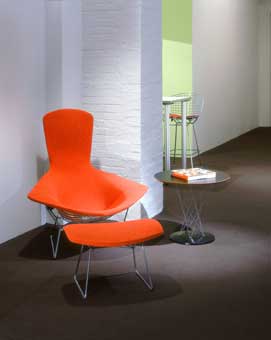
Harry Bertoia (1915, San Lorenzo, Italy – 1978, Barto, USA) Bird armchair (423 LC)
Steel, polished chrome, plastics, cloth Length, width, height: 98 x 84 x 102 cm Knoll has produced it since 1952
The armchairs and the stool were made of wire net, a material never previously used in such a way in furniture production. As early as in the nineteenth century people have made garden chairs of steel wire. However, Bertoia’s research of sculptural volume and its relation with the surrounding environment led to a modern use of wire net. By means of its form, Diamond and Bird contributed to a new design that humanized mannerist forms of modernism.
The designing of the Diamond armchair and other pieces of that collection took two years, and it was carried out with the support of the Knoll family that set no limits, even when it was clear that the Diamond armchair was easier made manually than by a machine. Bertoia had not been the only one who explored the shaping of the steel net in furniture production. Almost simultaneously, Charles Eames, Bartoia studied and cooperated with during the war years, and his wife Ray, also designed a collection of steel net made furniture (1951-1952).
The armchair Bird was named like that because it resembles a bird with open wings. Its functional addition is the stool.

Eero Saarinen (1910, Kirkonumi, Finland – 1961, Ann Arbor, USA) Tulip armchair (Tulip 150 AS) 1955-1956,
Tulip chair (Tulip 151CS) 1955-1956 Aluminum, plastics, cloth Length, width height: 51 x 54 x 81cm Knoll has produced it since 1956

Eero Saarinen (1910, Kirkonumi, Finland – 1961, Ann Arbor, USA)
Aluminum, laminated wood Diametre, height: 120 x 73 cm Knoll has produced it 1956
The Pedestal collection was made of cast plastics. It was the first time this technology was used, and it enabled Eero Saarinen to beget a piece of funiture entirely made out of an artificial material, which could easily be shaped. At the same time, this collection took the one-legged chair into the home interiors, and the collection was named to reflect that. The idea to design furniture with only one leg had been developed by Eero since 1953. After doyens of drawings, he managed to realize a series of models, followed by the prototype, whose production revealed new methods. The furniture from the Pedestal collection was first tried out at the dining-room and the parlor in the home of Eero’s friends in Bloomfield Hills. The chair in its form resembled a flower growing from the floor – and it was named Tulip. It just so happened that the Pedestal collection was the last thing Saarinen designed for Knoll.
Marija Bujić, curator at the Museum of Applied Art
Aleksandar Ećimović, Kubo
Bojana Popović, MA, curator at the Museum of Applied Art
Catalogue text:
Ivanka Zorić, director of the Museum of Applied Art
Boris Ećimović, director of Kubo
Bojana Popović, MA, curator at the Museum of Applied Art
Catalogue and exhibition design: Aleksandar Stanković, Studio Kubo
Exhibition curator:
Bojana Popović MA, Senior Curator
Lectures adhering to the “Modern Classics” exhibition
December 15th 2005, Žad Gallery
Mirco Opezzo, manager, Cassina
On Cassina’s History
Carl Magnusson, designer and one of the directors of Knoll
Funny Views on 3500 years of design
