 MENU
MENU
Programme Coordinator: Dejan Sandić, International Cooperation Curator
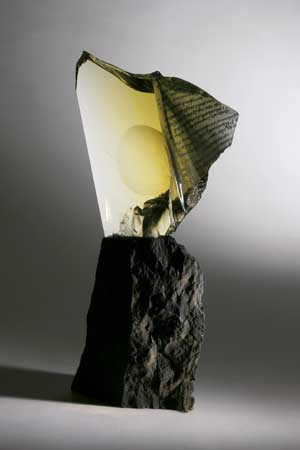
The search for adequate expressive resources for the new project by means of solitary works had a clear aim and it was only a question of time before Ľubomír Ferko would focus on the fourth most widespread religion on our planet – Buddhism. The project was originally more closely specified as Tibetan glass and its central theme was to be the underlying essence of the philosophy of Buddhist monks in the Tibetan monasteries.
However, The Tibetan Book of the Dead not only had a content level for the artist, which he wanted to interpret in an artistic language by means of glass sculpture, but also a formal level. Again, this was the calligraphy of the authentic text of prayers and description of rituals for the dead on the road to purity. The random smooth surfaces formed after the destruction of the massive glass material were chosen as the surfaces for the application of quotations from texts. The letter symbols are gradually reduced from rich drawing to linear entries, which become metaphors for the distant, pure and broad road of Tantric Buddhism on one side, and the almost threateningly drawn peaks of the vast Himalayan mountain range on the other. Ľubomír Ferko again reached for a combination of apparently incompatible materials – glass with physical properties such as fragility, transparency and plasticity, is in sharp contrast to the hardness, structuralness and elementalness of stone (zircon, granite). The tension of nature and form becomes a starting point for the artist to depict the drama of catharsis of the human being in harsh natural conditions on the way to salvation, as in the works: Karma, Reincarnation and Himalayan Flower.…
Ágnes Schramm, PhD. Curator at The Slovak National Gallery