
 MENU
MENU
The boxes in the Collection of Ljuba Ivanović represent the core of this collection. Purchases, gifts by donors, and bequests complemented the collection with the specimens that, in the best manner, illustrated the harmony of form, decorative programme and function. The boxes of various shapes and sizes were collected, from the miniature ones for pills and snuff, to the large size, travel chests. They were made of durable (metal, stone), hard (wood, bamboo, bone, mother-of-pearl, amber, celluloid) and delicate (paper, hay and textile) materials. Various decorative techniques were used for surface decoration, both exterior and interior, in accordance with the materials the boxes were made of (woodcarving, veneer, marquetry, intarsia, pressing, casting, chiseling, painting, toning, embroidery). They were mostly hand made by unknown masters and workshops. Some are products of industrial production of the end of the 19th and the first half of the 20th centuries.
The collection of boxes in Museum of Applied Art has never been exhibited as a whole. The travel box for glassware that belonged to King Milan Obrenović and the box for accessories (sitnarka) are exhibited at the permanent exhibition of the period furniture Trace in the Wood. The cigarette boxes were shown at the exhibition Ars Fumandi, 2007. The jewel of the collection, a miniature box for a medallion watch was shown in 2010 at the exhibition New in the Collections. Acquisitions 2001-2010. The largest part of the collection is being presented to the public only now. The special mention should be made of a box from Arkhangelsk Region in Russia made of walrus tusk, as well as a blue box made of lapis lazuli. An interesting story tails a 19th -century English snuffbox made of horn, lost on the road to Constantinople (Carigradski drum) in Serbia, dug out by our donor’s mother at the beginning of the 20th century who found it while working the field, half a meter below the ground. The box was filled with gold coins not snuff, and was kept by the family, as treasure. This precious item is a donation by the owner who had no heirs.
It is not possible to name all the functions of the boxes. As the societies developed, the needs to store various materials grew larger. Boxes underwent a long path in the history of their evolution, from the most ordinary containers, to the masterpieces of applied arts, where the shape and the manner in which they were made and decorated surpasses the main purpose – to store, to sort, to accentuate a value, or to hide or stash something,
There are boxes with interior organization of space that clearly points to their purpose. On the other hand, a considerable number of boxes have no special purpose, and it gets to be defined by its owner in relation to his/hers instant needs. The content of a box represents an indicator of social origin, source of wealth in the widest sense of the term, of knowledge, of deepest feelings of joy and sorrow, of love and gentleness, of pride and vanity.
Boxes, although the smallest type of furniture, stand as indubitable testimonies to the culture of life of the past epochs. The small dimensions have always been a challenge for the master cabinetmakers, demanding special skill and accuracy. In addition, box as an object possesses some other symbolic characteristics. Small or large, decorated or not, toned or not, for jewelry, for pills or for sewing kits, every box, either large or little, can say so much by itself. This is what this inspirational exhibition is all about.

Snuff-box (burmutica)
Skoplje, end of 19th century
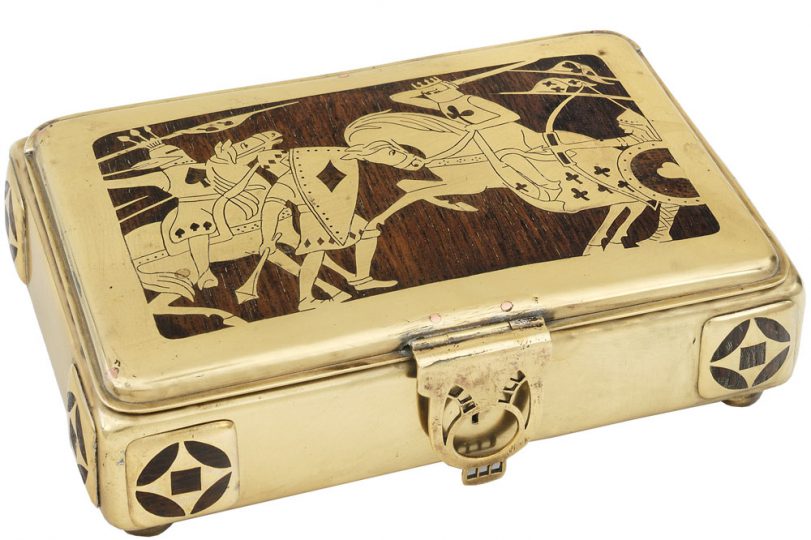
Playing Cards Box
Germany, 1910

Кутија за цигарете (табакера)
Vojvodina, mid 19th century

Cigarette-box,
The Kingdom of Yugoslavia, 1929-1941

Box
France, Sevres, 1840-1846

Cigarette-box (tabakera)
the Central Europe, second half of 19th century

Cigarette-box (tabakera)
Vienna, 1910

Match-box
Central Europe, 1883

Box for Writing Kit
Spain, end of 16th century

Box
Bohemia, Haida, 1895-1914

Box for Accessories (sitnarka)
Macedonia, 18th century

Glassware Travel Case
France, second half of 19th century

Tobaco Box,
Macedonia, end of 18th – beginning of 19th century

Cigarette-box
Egypt, 1903-1918

Tobaco box,
Bohemia, end of 19th century
