
 MENU
MENU
under the auspices of the Ministry of Culture of Serbia,
a representative exhibition titled
“PRESERVED TIME”
Author of the exhibition: Dušan Milovanović, Museum Advisor
We expect this to be one of the most representative exhibitions in Belgrade in 2005. A strong media support, outstanding Museum location (Vuk Karadzic street is located in the heart of the city), great public interest for the collection of old and valuable watches, as well as the world reputation of our house, are some of the arguments that speak in favour of the attractiveness of this cultural manifestation. The opening of the exhibition (September 15.) is planned to coincide with the opening of the European Basketball Championship ( Belgrade September 16, 2005); the exhibition is already part of their site, and we expect all athletes and guests to visit our exhibition, which will practically open the fall season of the cultural and art happenings in the capitol.
It is our intention, along with exhibiting this outstanding material, to consider at the same time the phenomenon of time, which is paid particular attention this year on the occasion of the a centennial of publication of the Theory of Relativity (Einstein’s year) all over the world.
“Preserved Time” is accompanied with representative bilingual catalogue written by author, Museum Councillor Dušan Milovanović. During the exhibition, in the period of three months numerous accompanying exhibitions will be opened (antiquities, watches produced by modern companies, shows…) accompanied with the lectures, projections, concerts that we hope will keep this manifestation continuously up to date and revisited again and again.

SHIP\'S COMPASS-SUNDIAL Ivory, hot-template engraved; metal alloy, glass 17 th century (first half), Nürnberg , Germany Made by: J acob Karner
Folding horizontal and vertical pocket diptych sundial with compass. Rectangular, composed of two plates of unequal thickness.
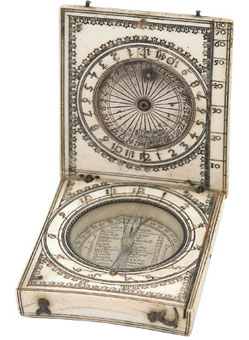
SHIP\'S COMPASS-SUNDIAL Ivory, hot-template engraved; metal alloy 17th century (first half), France (?)
Universal, folding (horizontal and vertical), pocket diptych sundial with compass. Housing of bone, decorated on the inside and outside with simple stylised floral (palmette) and geometrical patterns.
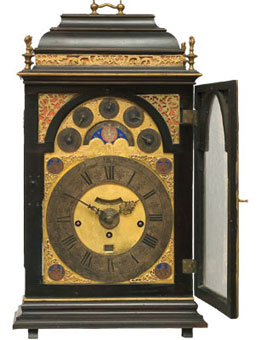
TABERNACLE CLOCK, astronomical Wood, cutting; bronze, casting, gilding; brass, forging, enchasing; enamel; glass 17th century (last third), Vienna , Austria Dial inscription: Anton Brack in Wien Baroque Spring powered, pendulum controlled; strikes quarter and full hours
Moulded base, resting on simple legs and bearing a r ectangular box, with bronze torches on the corners and a moulded roof on the top. The entire face plate is decorated with a perforated and gilded floral ornament. The numerals are Roman for the hours and Arabic for minutes; the hands are perforated. Four evangelist half-figures in circular medallions done in Limoges enamel are set into the corners.

TABERNACLE CLOCK - astronomical Wood, cutting, gilding; brass, forging, engraving; enamel; glass c. 1730, Vienna, Austria Dial inscribed: F. Widtge Wienn Baroque Spring powered, pendulum controlled; strikes quarter and whole hours
The r ectangular box which stands on four winged feet is decorated around the edges and door with prominent vertical golden stripes. The door is rectangular with an arched top on the inside, with floral branch appliqués in the corners. The hours on the dial are done in Roman numerals for hours and Arabic for minutes; an intertwined baroque plant arrangement is engraved in the ventral field. A small pendulum is visible through an arching opening above the axle as it moves, while a similar orifice below shows the days of the month. The finely-fashioned hands are perforated.

LANTERN CLOCK Brass, casting, forging, engraving; iron, forging 1737, Italy Dial inscription: DOM uis; MRA; FORNASINI FECIT=A=D MDCCXXXVII Baroque
Simple legs of circular section support a tall clock topped by a prominent bell positioned between four pillars. On the dial the figures are Roman for the hours and Arabic for the minutes. The two simple hands are spear-shaped. In the upper corners are simple garlands, while a central engraved medallion below the dial carries an inscription of the maker and year of manufacture.

TABLE CLOCK (ALARM) Bronze, alloys, cast, chiseled, engraved, gold plated; enamel; glass; 18th century (first half), Germany Signatures on dial and mechanism: J. G. KRIEDEL (Johann Gottfried), BUDISSIN ( Bautzen in Saxony ) Baroque Strikes at the full hour and quarters
The hexagonal casing, with glass windows on each side through which the mechanism can be seen, is placed on six lion paws holding small spheres, each morphing into a pair of wings.
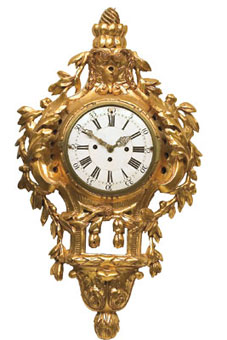
WALL CLOCK (Cartel) Wood, cutting, gilding; brass, casting; enamel 18th century (last quarter), Central Europe No markings Louis XVI Spring-powered, spindle-shaped escapement and pendulum
This lime-wood clock is shaped in the form of a stylised flower vase with a large bud on the bottom and symmetrical palmettes atop; the apex is a pine-cone around which fall around the dial rich garlands with sculpted leaves and buds and numerous perforations, all meticulously gilded.

LONGCASE CLOCK Wood, cutting, marquetry; steel, brass, casting, forging; copper, forging, enchasing, silver-plating; glass Late 18th century, Central Europe No markings Late Baroque Double-pendulum mechanism
The case rests on four arched legs with palmettes; the lower half has oval bulges in the middle and has a glazed opening in the form of a flower with four petals showing the moving pendulum. This half is decorated with two elegantly shaded marquetry medallions each with the profile of a parrot.

TABLE CLOCK (with original case) Wood (pear), ebonising, gilding; brass, pressing c. 1800, Vienna , Austria Made by: Johan Straub in Wien; workshop marked on mechanism Empire Strikes quarters; shows dates; two different chimes
Two addorsed sirens rise from the base and hold the round case of the clock on which sits Ganymede embracing an eagle with its wings spread wide. The figures are painted black and accentuated in gold

TABLE CLOCK Wood, cutting; bronze, brass, casting, enchasing, gilding; alabaster; glass c. 1810, Vienna , Austria Made by: Frenz Volenberg Empire Spring-powered mechanism, pendulum; strikes 1 and whole hours
The housing is in the shape of a triumphal arch on flattened sphere alabaster feet. The decoration is conceived as an apotheosis of the triumph of love. On the lower front two addorsed lions are shown each holding one paw on a vase. To the left and right are two winged Victories with wreaths as prepared for crowning. The central field is especially elaborately done: it is glazed with a mirror reflecting alabaster pillars and the (semi)moulded figure of a winged Eros holding a bow in his right hand. The decorative arch completing the scene is filled with very complex and rich signage: a heraldic shield with weapons and Silenus (2 x), a twin garland, and on the top the symbol of the Sun; two torch-vases are placed laterally near the bases of the pillars.

TRAVELLING CLOCK Silver, forging; steel; enamel; glass 1889/90; housing: London , England ; mechanism: Paris , France Maker\'s inscription: W.W F.D; mechanism: S F PARIS Spring-powered mechanism
The simple silver box with rounded rims rests on feet shaped as flattened spheres; on top is a heart-shaped handle, around the white dial with Roman numerals is a simple ring. This is a so-called “Diligence” ladies\' travel clock.
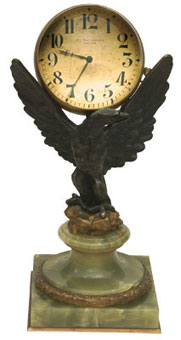
TABLE CLOCK Bronze, casting; green onyx, carving, glass c. 1890, Lucerne , Switzerland Inscription: Mce BREITSCHMID, Lucerne Historicism Spring-powered, with a fast oscillator
A rectangular onyx plate supports a circular base edged with a bronze wreath at the bottom; on the base stands an eagle with its wings spread wide and holding a double lens through which can be seen the dial on the front and the mechanism on the other side.

POCKET WATCH Alloy, casting, cutting; silver, casting, cutting, filigree, gilding, enamel; tortoiseshell Watch : m id-18th century, Paris , France ; outer case: Thessaloniki Inscription on dial and mechanism: LE ROY, A PARIS
Composed of three cases, with the mechanism and dial in the innermost. The outer case is silver and decorated with filigree arabesques; in the centre of the face side is a circular medallion with a saying from the Quran, while the back has a six-pointed star in the centre. The middle case is tortoiseshell attached with tiny silver nails and decorated on the back with a six-pointed filigree star. The smallest case is silver, and the dial is done on a gilded silver plate with a flower vase in its centre; Arabic (Turkish) numerals are written on enamel fields for the hours and minutes. The mechanism is gilded and spring-powered.

POCKET WATCH Brass, casting, cutting, gilding; silver, casting, forging, engraving; enamel; tortoiseshell; glass 1750/51, London , England Mechanism inscription: Edw. Prior, 78405, London ; dial inscription: EDWARD PRIOR LONDON; goldsmith: WCS
Four cases. The outermost a protective one is shaped as a grooved protruding seashell; the next one is tortoiseshell with rows of tiny silver nails and gilded and engraved ornamented rims; a smaller silver case is decorated with engravings, while the bottom has a representation of the triumph of Islamic weapons. The innermost plain silver case contains the gilded mechanism and a white enamel dial with Turkish numerals. The accompanying long silver chain is of multiple-woven wire with cast buckles and a filigree/granulation “button”.

POCKET WATCH Brass, casting, forging; silver, casting, forging, gilding; enamel 18th century (second half), Linz , Austria Mechanism marked: Philip Grazl Linz 564; innermost case: G W
Two cases; the outer one is silver and coated externally with reddish enamel to imitate tortoiseshell; along the rims of both sides rows of tiny silver nails have been hammered in. The internal case is perforated and decorated with minutely executed floral motifs.

POCKET WATCH Brass, casting, forging; silver, casting, forging, gilding; enamel 18th century (second half), Linz , Austria Mechanism marked: Philip Grazl Linz 564; innermost case: G W
Two cases; the outer one is silver and coated externally with reddish enamel to imitate tortoiseshell; along the rims of both sides rows of tiny silver nails have been hammered in. The internal case is perforated and decorated with minutely executed floral motifs.

POCKET WATCH Steel, cutting, silver, casting, cutting; enamel; white sapphire c. 1930, Geneva , Switzerland Signed on inner lid: GENEVE, SWIS, BREVET, G. Schwab Lolille; motto inscribed on dial: LOVE YOUR FELLOW MAN LEND HIM A HELPING HAND; owner\\\'s initials: ? ?.
Triangular pocket watch with numerous Masonic symbols. On the rear lid, below the “all- seeing eye”, is a table in a portico (lodge), with a book, a dagger and two menorahs, with the Sun above. On the left are the following symbols: a book, a sword, a book-mark, and on the right a wooden mallet, a trowel, a pair of compasses and an protractor; both compositions are superimposed on laurel branches; above the eye is a large “G”. The rims are also filled with symbols: on the left are compasses, crossed hammer and trowel, and two crossed swords; below are two triangles and three pentacles; on the right rim first there is a diving dove, followed by a pentacle in triumph, and lowest a closed window.

POCKET WATCH Steel, cutting, silver, casting, cutting; enamel; white sapphire c. 1930, Geneva , Switzerland Signed on inner lid: GENEVE, SWIS, BREVET, G. Schwab Lolille; motto inscribed on dial: LOVE YOUR FELLOW MAN LEND HIM A HELPING HAND; owner\'s initials: ? ?.
Triangular pocket watch with numerous Masonic symbols. On the rear lid, below the “all- seeing eye”, is a table in a portico (lodge), with a book, a dagger and two menorahs, with the Sun above. On the left are the following symbols: a book, a sword, a book-mark, and on the right a wooden mallet, a trowel, a pair of compasses and an protractor; both compositions are superimposed on laurel branches; above the eye is a large “G”. The rims are also filled with symbols: on the left are compasses, crossed hammer and trowel, and two crossed swords; below are two triangles and three pentacles; on the right rim first there is a diving dove, followed by a pentacle in triumph, and lowest a closed window.

WATCH CHAIN (Oriental) Silver, casting, granulation, filigree; niello Late 18th century, Prizren
